15% fall discount applied automatically at checkoutFree USA shipping over $100Free worldwide shipping over $200Credit/debit checkout disabled for updates
Sign in 0

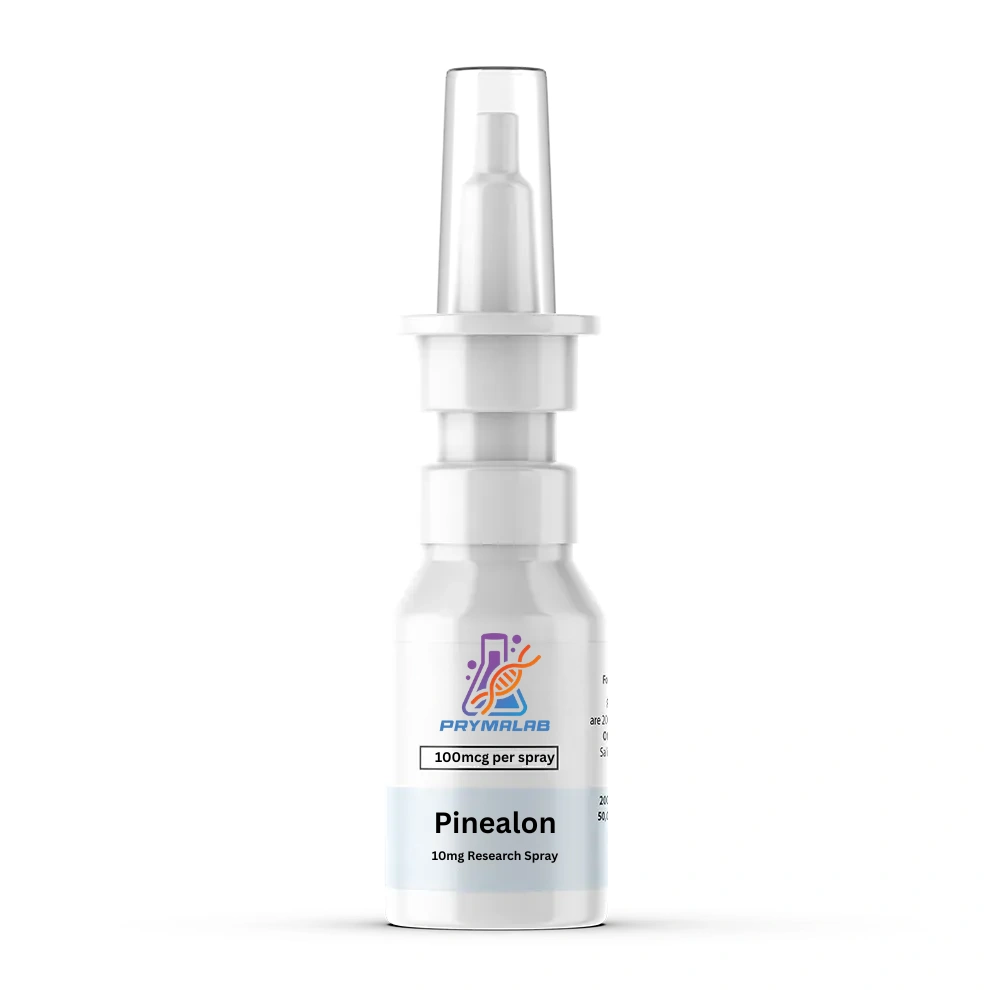
Pinealon 10mg Nasal Spray

(5 customer reviews)

$59.99 or subscribe for $50.99/mo

Pinealon nasal spray supplies the tripeptide Glu-Asp-Arg in a metered solution format. Its charge sits close enough to neutral that container material changes the delivered amount rather than merely documenting it. Laboratory research use only.

Description

PrymaLab · Research Use Only

Pinealon Nasal Spray

Glu-Asp-Arg tripeptide · 418.4 Da · Cardiogen minus one residue

Pinealon nasal spray supplies the tripeptide Glu-Asp-Arg in a metered aqueous solution at roughly 418.4 daltons. One arginine against two acidic residues leaves the molecule close to electrically neutral, and near-neutral peptides are the ones that disappear onto container walls.

Specification Table

Pinealon nasal spray format and handling data
Property Value
Compound Pinealon
Sequence designation EDR
Amino acid sequence Glutamate-Aspartate-Arginine
Sequence provenance Secondary sources, converging. Not traced to a single primary citation. Confirm against the lot certificate before relying on it for calculation
Residue count 3
Molecular weight, calculated Approximately 418.4 g/mol, computed from standard residue masses plus water
Parent compound in the catalogue Cardiogen (Ala-Glu-Asp-Arg) at roughly 489.5
Relationship Identical to Cardiogen minus its amino-terminal alanine
Mass gap from Cardiogen Roughly 71 daltons, the residue mass of alanine
Net charge at neutral pH Near neutral. One arginine against two acidic residues
Comparable charge state in this range Vilon and Livagen
Chromophore None. Concentration cannot be determined by 280 nm absorbance
Oxidation-prone residues None
Format Metered nasal spray, solution state
Physical state Aqueous solution, supplied ready to use
Purity Per lot-specific certificate of analysis
Storage 2-8°C, protected from light. Do not freeze
Regulatory status No approved human or veterinary formulation in any jurisdiction

Why Does Container Material Change the Delivered Amount?

Adsorption is usually a footnote in a handling section. For pinealon nasal spray it belongs at the top of the page.

Charged molecules are repelled by container surfaces carrying the same sign, and that repulsion is what keeps them in the bulk solution rather than on the wall.

This compound has one arginine pulling positive and two acidic residues pulling negative, which leaves very little net charge to do that work.

Without electrostatic repulsion the molecule contacts glass and polypropylene freely and a fraction of it stays there.

At the concentrations a nasal spray delivers, that fraction is measurable rather than negligible, and it is not reflected anywhere on the label.

The loss also grows as a bottle empties, since the ratio of wall surface to solution volume rises with every actuation.

A bottle used over months therefore delivers progressively less peptide per identical metered volume. That is a real experimental artefact and an easy one to miss.

That makes container material a variable affecting the result rather than a detail worth recording for completeness, and it is the single most useful thing to know about this product.

What Can Be Done About It?

Three mitigations are available to a pinealon nasal spray user and none is expensive, which makes the usual neglect of this issue harder to justify.

Low-binding consumables are the obvious first answer for anything decanted from the primary bottle, and they cost marginally more than standard ones.

Pre-saturation is the second and it costs nothing. Adsorption reaches equilibrium rather than continuing indefinitely, so rinsing a transfer vessel with a small volume of the same solution and discarding it saturates the surface before the working aliquot is drawn.

Carrier protein in the diluent is the third, where an assay tolerates it, since abundant protein occupies binding sites the peptide would otherwise take.

None of those addresses the primary container the product ships in. That is where the loss begins and where the buyer has no choice.

The practical response there is to use a bottle within a defined period rather than holding it open for many months, since time and emptiness both work against recovery.

Recording the container material alongside the concentration is what makes any of this recoverable afterwards, and it takes one field.

Three compounds in this range share the near-neutral problem, this one along with Vilon and Livagen, and the same measures apply to all three.

A fourth option exists and it is worth mentioning even though it applies to few experiments.

Raising the ionic strength of the diluent screens electrostatic interactions generally, which reduces both the attraction and repulsion governing adsorption.

For a near-neutral molecule the net effect is usually a modest reduction in surface loss, though how much depends on both the surface and the salt.

Where an assay tolerates additional salt, it is a cheap adjustment to test alongside the container change rather than instead of it.

What Does the Cardiogen Relationship Mean?

This compound is what remains when another product in the catalogue loses a residue, which frames a specific quality question.

Cardiogen reads Ala-Glu-Asp-Arg. Strip the alanine off the front and Glu-Asp-Arg remains, which is precisely this compound.

Since synthesis builds a chain backwards from the carboxy terminus, that alanine is the final residue added to Cardiogen.

A failed final coupling on a Cardiogen batch therefore produces this compound rather than an anonymous fragment, and this compound has its own name and its own price.

The gap is roughly 71 daltons, putting Cardiogen near 489.5 against roughly 418.4 here, which any mass spectrometer resolves comfortably.

For a buyer of this product the concerning direction is carryover, which would introduce a heavier species near 489.5 from a Cardiogen batch run on shared equipment.

That is the mirror of the question a Cardiogen buyer should ask, and one conversation with a supplier covers both.

It also illustrates the wider pattern in this family: four separate pairs where one product is the expected truncation impurity of another, all sold from the same catalogue.

The pattern extends further than this one pair, which is worth seeing whole.

Chonluten is Epitalon minus alanine. Ovagen is Bronchogen minus alanine. This compound is Cardiogen minus alanine. Vesilute is Cartalax minus alanine.

Four separate pairs, all differing by the same residue, all with both members sold from the same catalogue.

That is a consequence of building a product family from an alanine-extended series, and it means the same certificate question applies four times over.

Asking it once, in general terms, is more efficient than asking it four times about four compounds. A supplier who has thought about the alanine series at all will recognise the question immediately.

One who has not will regard each pair as unrelated, which tells you something useful about how the material was made and checked.

The alanine series is the organising fact about this product family, and very few vendors describe it as one.

What Does the Arginine Contribute?

One residue carries most of what distinguishes this compound from the purely acidic members of its family.

Arginine has a guanidinium group with a pKa near 12.5. So it stays protonated across every buffer condition a laboratory realistically uses.

That fixed positive charge is what offsets the two acidic residues and produces the near-neutral state described above.

It also makes the compound more water soluble than a purely acidic tripeptide of the same size, which is a genuine convenience during formulation.

The guanidinium is a hydrogen bond donor at multiple positions, which is why arginine is common at protein-nucleic acid interfaces.

For a family whose proposed mechanism involves interaction with DNA, an arginine is a structurally suggestive residue to find, and this compound and Cardiogen are the only two that carry one.

That observation is worth stating carefully. It makes the hypothesis structurally plausible for these two compounds without providing any evidence that it is correct.

No binding study, no structure and no affinity measurement exists for any compound in this family, so the residue is suggestive rather than confirmatory.

How Does 418 Daltons Sit for Delivery?

Size is favourable for pinealon nasal spray, as it is across this family, and it is not what distinguishes the compound.

The paracellular route between epithelial cells stops carrying useful quantities somewhere near 1,000 daltons. This sits at well under half of that.

At roughly 418.4 daltons it falls between Ovagen at roughly 375.4 and Cortagen at roughly 430.4, in the middle of the family band.

Three residues with no aromatic side chain gives low hydrophobicity. So paracellular passage does the work rather than a transcellular route.

Charge is where the interest lies, and near-neutral is arguably the least favourable of the three possibilities at a mucosal surface.

A cationic peptide gains residence time from mucoadhesion. An anionic one is cleanly repelled and passes on. A neutral one gets neither the retention nor the clean rejection.

That said, none of the three has been shown superior for short peptide nasal delivery, and this catalogue happens to contain examples of all three at comparable size.

No published study characterises this compound given nasally, so the account above is structural rather than measured.

What Does the Neuroprotection Claim for Pinealon Rest On?

This compound is sold on a neuroprotection argument, and it has more primary work behind it than most of the family, which makes the argument worth reading closely rather than dismissing.

The EDR peptide appears in a specific line of rodent work from the originating programme, and the model used is unusual enough to state plainly.

Rats were exposed to prenatal hyperhomocysteinemia, an elevated homocysteine state induced in the mother, which damages the developing brain and gives a reproducible neuropathology to score against.

Reported effects in that model include fewer necrotic cells in the hippocampus, altered expression of proapoptotic proteins including caspase-3, and preserved dendritic spines.

Those readouts are cellular. Learning ability was also scored behaviourally in some of that work, which is the closest anything in this family comes to a functional endpoint.

The proposed mechanism of action runs through gene expression rather than through a receptor, with MAPK/ERK signaling pathways named in the discussion sections.

Reduced oxidative stress is the other half of the argument, with free radicals and reactive oxygen species offered as what the peptide is supposed to be protecting against.

Protein synthesis is where those two strands meet in the programme’s account, since a peptide binding DNA and shifting transcription would change what a cell builds.

That is a coherent story and it is also one programme’s story, replicated by nobody outside it.

Alzheimer’s disease is the condition attached to this compound most often in vendor copy. No trial of this compound in Alzheimer’s disease has ever been run.

Huntington’s disease appears in the same listings, as do neurodegenerative diseases generally. The hyperhomocysteinemia model is not a model of Alzheimer’s disease or of Huntington’s disease, and results in it do not transfer to either.

Cognitive function, cognitive enhancement and anti-aging claims follow from that same copy rather than from the papers. Nothing in the record measures cognition in a human being.

Serotonin turns up in some listings because of the pineal association in the name. This compound is a tripeptide with no structural relationship to a monoamine and no published effect on serotonin.

The honest summary is that the neuroprotective effects reported here are cellular readouts in one injury model from one group, and every step from there toward a claim about a human brain is unsupported.

How Does Pinealon Compare With the Nootropic Peptides?

This compound is shelved with a group of peptides marketed for the brain, and the group mixes very different amounts of evidence.

Semax and Selank come from a separate Russian programme. Both are longer, both carry larger published records, and both have been studied intranasally, which this compound has not.

Selank in particular is the comparison worth making, since Selank has published intranasal pharmacokinetic work and this compound has none at all.

Cortexin is a polypeptide extract rather than a defined sequence, so it relates to the bioregulators historically rather than structurally.

DSIP, oxytocin, GHK-Cu and BPC-157 fill out the rest of the nootropic shelf. None is a bioregulator and none shares the proposed mechanism here.

Oxytocin matters as a reference point because it is the short peptide with the largest intranasal literature, and intranasal insulin is the other well-studied case for anyone reading into nose-to-brain transport.

Both of those show that a peptide nasal spray can reach the central nervous system in measurable quantity. Neither shows anything about this molecule.

Bioavailability by the nasal route has never been measured for this compound, so no bioavailability figure quoted for it anywhere has a source.

Compounding pharmacies dispense several of these peptides against a prescription. This product is not compounded, not prescribed, and not for administration to anyone.

Does Pinealon Nasal Spray Need Reconstitution?

No. This liquid spray arrives at its fill concentration, so no bacteriostatic water is added and nothing is weighed.

Where the compound is sold in peptide vials as a powder, the buyer does that arithmetic, and lyophilized peptides carry the counterion and residual water problem a liquid spray removes.

What a liquid spray does not remove is the container problem this page opens with, since adsorption acts on the primary bottle regardless of how the solution got there.

Sterility is worth a sentence too. An opened aqueous container supports microbial growth, and a liquid spray has no reconstitution step at which anyone would think about it.

Record the storage condition the bottle was held under and the date it was opened, because for a solution product those two fields carry what a powder buyer would learn by weighing.

The molecular weight computes to roughly 418.4 from the stated sequence. Oral administration figures quoted for this family do not apply to a spray, and no nasal figure exists to replace them.

What Research Position Applies?

The published record belongs to the compound rather than to this format.

Aged rodent and cell-culture observations appear in work from the St Petersburg group, assessed by histology and by markers of tissue-associated gene expression.

Those studies used parenteral routes. No published work describes this compound given by the nasal route.

Cell-culture work across the family on chromatin decondensation is advanced in support of the DNA-binding hypothesis rather than of any organ-specific claim.

No receptor has been identified for any compound in this family and no binding constant is published, so no concentration follows from first principles.

Nobody has run an adequately powered independent Western trial on this compound, or on any of the fifteen alongside it.

Sequence provenance rests on converging secondary sources rather than a traced primary citation, which the specification table states directly.

How Should Pinealon Nasal Spray Be Stored and Recorded?

Chemically pinealon nasal spray is undemanding, and the interesting field in the record is the container rather than the temperature.

Refrigerate between 2 and 8 degrees Celsius, keep the bottle dark, and never freeze a solution-state product.

No cysteine, methionine or tryptophan means oxidation and photodegradation are absent, so light protection is a precaution.

Arginine follows the aspartate here rather than glycine, and that substitution slows the succinimide rearrangement well below the rate seen in the Asp-Gly members of this family.

Adsorption is the concern that does apply and it is the reason this page leads with container material rather than with chemistry.

Use low-binding surfaces for anything decanted, pre-rinse transfer vessels, and use an opened liquid spray within a defined period rather than indefinitely.

An unopened liquid spray held at the stated temperature is the stable case. Everything that follows opening is a slow drift nobody measures unless the record makes it visible.

Log the lot, the stated concentration, the container material, the opening date, the storage temperature and the actuations drawn.

Where a result depends on delivered amount rather than on presence or absence, the container field is the one most likely to explain a discrepancy nobody else can account for. It is also the field most often left blank, which is why an unexplained drift between early and late experiments on the same bottle so often goes unresolved.

Published Literature

Selected references. The bioregulator literature originates almost entirely from one research programme and used parenteral routes.

  1. (‘Khavinson VK, Malinin VV. Gerontological Aspects of Genome Peptide Regulation. Basel: Karger; 2005.’, ‘https://doi.org/10.1159/isbn.978-3-318-01193-6’)
  2. (‘Anisimov VN, Khavinson VK. Peptide bioregulation of aging. Biogerontology. 2010;11(2):139-149.’, ‘https://doi.org/10.1007/s10522-009-9249-8’)
  3. (‘Goebel-Stengel M, Stengel A, Tache Y, Reeve JR. The importance of using the optimal plasticware and glassware in studies involving peptides. Anal Biochem. 2011;414(1):38-46.’, ‘https://doi.org/10.1016/j.ab.2011.02.009’)

Frequently Asked Questions

What is Pinealon nasal spray?

A metered aqueous solution of the tripeptide Glu-Asp-Arg at roughly 418.4 daltons. Supplied for laboratory research only. Not a single jurisdiction has approved any formulation of it.

Why does container material matter so much?

Because one arginine against two acidic residues leaves almost no net charge, and it is net charge that repels a molecule from container surfaces. Without it, the peptide contacts the wall freely and some stays there.

How large is the effect?

Measurable rather than negligible at spray concentrations, and it grows as a bottle empties because the ratio of wall surface to solution volume rises with every actuation.

What is the practical consequence?

A bottle used over months delivers progressively less peptide per identical metered volume. That is a real experimental artefact and it appears nowhere on the label.

What mitigations exist?

Low-binding consumables for anything decanted, pre-rinsing a transfer vessel with the solution to saturate binding sites before drawing an aliquot, and carrier protein in the diluent where an assay tolerates it.

Do those fix the primary bottle?

No. The loss begins in the container the product ships in, where the buyer has no choice. The response there is to use an opened bottle within a defined period rather than indefinitely.

What is the Cardiogen relationship?

Cardiogen reads Ala-Glu-Asp-Arg, and taking its alanine away leaves this compound. A failed final coupling on a Cardiogen batch produces this compound rather than an anonymous fragment.

Which direction concerns a buyer here?

Carryover. A Cardiogen batch run on shared equipment would introduce a heavier species near 489.5 into this product, which is the mirror of the question a Cardiogen buyer should ask.

What does the arginine contribute?

A fixed positive charge from a guanidinium group with a pKa near 12.5, better water solubility than a purely acidic tripeptide, and multiple hydrogen bond donors.

Is that relevant to the mechanism?

Suggestively rather than confirmatorily. Arginine is common at protein-nucleic acid interfaces, which makes the DNA-binding hypothesis structurally plausible here without providing any evidence it is correct.

How does its size sit for delivery?

At roughly 418.4 daltons it falls between Ovagen at roughly 375.4 and Cortagen at roughly 430.4, well under the transition weight. Charge rather than size is what distinguishes it.

What does the neuroprotection work actually show?

Rodent work in a prenatal hyperhomocysteinemia model: fewer necrotic cells in the hippocampus, altered caspase-3 expression, preserved dendritic spines. Those are cellular readouts of neuroprotection in one injury model from one programme, replicated by nobody outside it.

Is Pinealon a treatment for Alzheimer’s disease?

No. Alzheimer’s disease is attached to this compound throughout vendor copy and no trial of it in Alzheimer’s disease has ever been run. The hyperhomocysteinemia model is not a model of that pathogenesis, so results in it do not transfer.

Does it improve cognitive function?

Nothing in the record measures cognitive function in a human being. Learning ability was scored behaviourally in some rodent work, which is the closest this family comes to a functional endpoint, and it is a long way from a cognitive enhancement claim.

How does it compare with Semax or Selank?

Semax and Selank come from a separate Russian programme, are longer, and have been studied intranasally. Selank has published intranasal pharmacokinetic work. This compound, a three-residue neuropeptide fragment by comparison, has none.

Does Pinealon nasal spray need reconstitution?

No. The liquid spray arrives at fill concentration, so no bacteriostatic water is added. Powder sold in peptide vials does need that step, and lyophilized peptides carry a counterion and residual water problem this liquid spray removes.

What is the oxidative stress argument?

That the peptide reduces oxidative stress by limiting free radicals and reactive oxygen species, alongside a gene expression effect running through MAPK/ERK signaling pathways. Both strands come from the originating programme and neither names a receptor.

Compliance Statement

Pinealon nasal spray is sold exclusively for laboratory research use. It is not a drug, food, or cosmetic product, and it is not a dietary product of any kind. It is not approved by the FDA or any comparable authority for human or veterinary use, its proposed mechanism has not been independently established, no published study characterises this compound delivered intranasally, and adsorption losses at spray concentrations mean the delivered amount may fall below the stated concentration. This product is not intended to diagnose, treat, cure, or prevent any disease. It must not be given to humans or animals. Purchase is restricted to qualified researchers and institutions operating within applicable laws. All handling is the responsibility of the purchasing laboratory.

Other formats of Pinealon

Pinealon is also stocked as Pinealon 5mg, Pinealon 10mg, Pinealon 20mg and Pinealon 6mg preloaded 3ml pen. Each listing states its own quantity and concentration, and the pen and vial comparison explains what changes between formats.

Additional information

Weight N/A
Dimensions N/A

5 reviews for Pinealon 10mg Nasal Spray

  1. Spencer Sanders
    August 2, 2026
    Tested good
    Had this order sent off to Janoshik for testing and it just came back with a perfect on the endotoxin testing and a purity of 99.97%. I will be shoppi...More
    Had this order sent off to Janoshik for testing and it just came back with a perfect on the endotoxin testing and a purity of 99.97%. I will be shopping here from now on, no vendor that I trust has better pricing.
    Helpful? 0 0
    Damon Gray
    August 2, 2026
    Thanks.
    Shipping was slow but everything came as it should.
    Helpful? 0 0
    Paula Harper
    August 1, 2026
    quality on point!
    test came back 99.71%. Will be back fs
    Helpful? 0 0
    Beverly Jones
    August 1, 2026
    Already seeing results!
    Shipping was slow but after only a week I am already seeing amazing results. Thank you.
    Helpful? 0 0
    Curtis Harper
    July 30, 2026
    will be back
    thanks
    Helpful? 0 0

Only logged in customers who have purchased this product may leave a review.
Peptide Research Articles

Bacteriostatic water depiction

Bacteriostatic Water Peptide Science: Why It Matters in Reconstitution & Research

Bacteriostatic water peptide science is the foundation of safe, accurate peptide reconstitution. This 2026 guide covers bacteriostatic water composition, how to reconstitute peptides using a peptide reconstitution calculator and peptide dosage calculator, bacteriostatic water vs sterile water differences, peptide storage best practices, and a 10-step reconstitution protocol. Expert insights from PrymaLab.

wolverine blend article vial

Peptides for Injury Recovery: The Wolverine Stack Peptide Guide (BPC-157 + TB-500)

The Wolverine stack peptide combines BPC-157 and TB-500 for research into tendon, ligament, and joint recovery. This 2026 guide covers BPC-157 peptide where to buy responsibly, BPC 157 peptide side effects, peptides for tendon repair, peptides for joint recovery, peptides for elbow pain, and the BPC-157 TB-500 peptide blend scientific research. Expert insights from PrymaLab.

are peptides healthy

Are Peptides Good for You? A Complete 2026 Guide

Are peptides good for you? This comprehensive 2026 guide explores peptide therapy benefits, safety, side effects, and how peptides work in the body. Learn about peptide health benefits, research findings, and what you need to know before considering peptide therapy. Expert insights from PrymaLab.

Ovagen peptide capsules for liver health with dosage cycling chart showing 10-20 day protocols repeated 2-3 times per year

Ovagen Peptide Guide: Uses, Research, Safety & Buying Info

Ovagen peptide is a short-chain liver bioregulator developed at the St. Petersburg Institute of Bioregulation and Gerontology under Professor Vladimir Khavinson. It contains the AC-3 peptide complex (glutamic acid and aspartic acid) designed to target hepatocyte gene expression for liver cell repair, bile production, and detoxification. This guide covers dosing protocols, cycling schedules, side effects, a head-to-head comparison with NAC, milk thistle, TUDCA, and BPC-157, cost analysis ($120-360 per year), and how to verify genuine Ovagen products online.

GHK-Cu peptide vial and syringe with dosage chart showing injection protocols for skin rejuvenation and hair growth

GHK-Cu Peptide: Benefits, Dosage, Side Effects & Complete Research Guide (2026)

GHK-Cu peptide is a naturally occurring copper tripeptide that modulates over 4,000 human genes involved in collagen synthesis, wound healing, and tissue regeneration. This comprehensive guide covers injection dosage protocols, clinical research on skin rejuvenation and hair growth, side effects, safety data, and how to reconstitute GHK-Cu 50mg vials. Includes dosage charts, comparison tables, and 10 frequently asked questions answered by a peptide research specialist.

Sermorelin dosage guide for anti-aging muscle growth and weight loss showing GHRH analog pituitary stimulation

Sermorelin Dosage Guide 2025: Complete Protocol for Anti-Aging, Muscle Growth & Weight Loss

Sermorelin acetate is a growth hormone-releasing hormone (GHRH) analog that stimulates natural GH production from the pituitary gland. This comprehensive dosage guide covers protocols for anti-aging, muscle growth, weight loss, and sleep optimization — along with side effects, before-and-after timelines, and comparisons to HGH and ipamorelin.

Customer reviews

4.60
Based on 5 reviews
5
60%
3
4
40%
2
3
0%
0
2
0%
0
1
0%
0
Spencer Sanders
August 2, 2026
Tested good
Had this order sent off to Janoshik for testing and it just came back with a perfect on the endotoxin testing and a purity of 99.97%. I will be shoppi...More
Had this order sent off to Janoshik for testing and it just came back with a perfect on the endotoxin testing and a purity of 99.97%. I will be shopping here from now on, no vendor that I trust has better pricing.
Helpful? 0 0
Damon Gray
August 2, 2026
Thanks.
Shipping was slow but everything came as it should.
Helpful? 0 0
Paula Harper
August 1, 2026
quality on point!
test came back 99.71%. Will be back fs
Helpful? 0 0
Beverly Jones
August 1, 2026
Already seeing results!
Shipping was slow but after only a week I am already seeing amazing results. Thank you.
Helpful? 0 0
Curtis Harper
July 30, 2026
will be back
thanks
Helpful? 0 0
24/7 Online support

support@prymalab.net info@prymalab.net

Money back guarantee

30 Day return window. Satisfaction guaranteed or your money back.

FREE shipping and return

All orders over %150 in value will receive free shipping.